
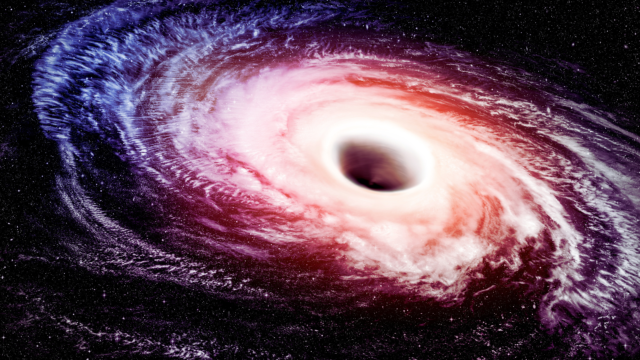
Black holes are among the universe’s most enigmatic cosmic objects, captivating scientists and enthusiasts alike. A black hole is formed when a massive star collapses under its own gravitational pull, creating a region in space where the gravitational field is so strong that not even light can escape. This unique characteristic makes them difficult to observe directly, leading to a wealth of theoretical exploration and discovery.
The study of black holes opens the door to understanding fundamental aspects of physics, including the behaviour of matter and energy under extreme conditions. As researchers continue to unravel the mysteries surrounding these celestial phenomena, they reveal insights into the nature of spacetime and the evolution of galaxies within the vast expanse of the universe.
Through recent advancements in technology and observational techniques, black holes are no longer just theoretical constructs. They have become a focal point for scientific research, providing valuable information about the workings of the cosmos and challenging our perceptions of reality.
Formation and Types of Black Holes
The formation of black holes occurs through various processes, primarily involving massive stars and their end-of-life events. The types of black holes include stellar-mass, supermassive, intermediate-mass, and primordial, each with unique characteristics and formation scenarios.
The Birth of Black Holes
Black holes typically form from the remnants of massive stars that undergo supernova explosions. When a massive star exhausts its nuclear fusion fuel, it can no longer support itself against gravitational collapse. This collapse leads to the formation of either a neutron star or a black hole, depending on the mass of the core remaining after the explosion.
If the core’s mass exceeds approximately 2.5 solar masses, it is likely to form a black hole. The gravitational pull of the collapsing core becomes so intense that not even light can escape, resulting in the creation of a black hole.
Stellar-mass Black Holes
Stellar-mass black holes usually form from individual massive stars that end their life cycles through supernovae. These stars typically have masses greater than 20 times that of the Sun.
After the supernova, if the remnant core is over 2.5 solar masses, it collapses into a stellar-mass black hole. This type can have masses ranging from about 3 to 50 solar masses. The process leaves behind a nebula, marking the death of the star and the birth of the black hole.
Supermassive Black Holes
Supermassive black holes exist at the centres of galaxies, including the Milky Way. They have masses ranging from millions to billions of solar masses.
The formation mechanisms for these black holes are not fully understood. Some theories suggest they may form from the direct collapse of massive gas clouds or through the merging of several stellar-mass black holes. Another possibility is their growth from smaller black holes by accumulating matter over billions of years.
Intermediate-mass Black Holes
Intermediate-mass black holes fill the mass gap between stellar-mass and supermassive black holes, typically ranging from 100 to several thousand solar masses. Evidence of their existence largely comes from observations of their activity in dense star clusters.
The formation of these black holes remains uncertain. Some theories propose that they may arise from the merging of multiple stellar-mass black holes or via the runaway collision of stars in dense environments. Their presence hints at complex evolutionary processes in stellar systems.
Primordial Black Holes
Primordial black holes are theorised to have formed shortly after the Big Bang. These black holes could have originated from density fluctuations in the early universe during the rapid expansion phase.
Their masses could vary significantly, from tiny black holes with the mass of asteroids to larger ones comparable to stellar-mass black holes. While they remain hypothetical, the search for primordial black holes is ongoing, as their discovery could provide insights into the early universe’s conditions and the nature of dark matter.
Characteristics and Physics
Black holes possess unique features driven by the fundamental principles of physics. They exhibit extreme gravitational effects, influencing surrounding matter and light. The interplay of these characteristics provides insight into their mysterious nature and helps frame the understanding of different astrophysical phenomena.
Event Horizon and Singularity
The event horizon represents the boundary around a black hole beyond which no light or information can escape. Once an object crosses this threshold, it is inexorably pulled towards the centre. The singularity lies at the heart of the black hole, where densities become infinite, and the laws of physics as described by general relativity cease to apply.
Subrahmanyan Chandrasekhar contributed significantly to understanding black hole formation, particularly in how massive stars collapse. The mathematical descriptions of these entities challenge current physics, as the singularity defies the comprehension of space and time.
Gravitational Pull and Escape Velocity
Black holes exhibit a remarkable gravitational pull due to their immense mass concentrated in a small volume. This results in a powerful field that significantly influences surrounding objects. The escape velocity at the event horizon equals the speed of light, meaning nothing — including light itself — can escape once it crosses this point.
The strength of a black hole’s gravitational influence dictates the behaviour of nearby matter, forming accretion discs and influencing stellar orbits. This gravitational dominance tests theories proposed by Einstein’s general relativity, particularly concerning spacetime curvature.
Hawking Radiation and Information Paradox
Hawking radiation, proposed by Stephen Hawking, suggests black holes can emit radiation due to quantum effects near the event horizon. This indicates that black holes are not entirely black and can emit particles, leading to their gradual evaporation over time. This theory introduces the information paradox, questioning whether information that falls into a black hole is lost forever.
This paradox challenges the conventional understanding of information conservation in quantum physics. Exploring the implications of Hawking radiation leads to ongoing debates in theoretical physics, as scientists seek to reconcile quantum mechanics with general relativity.
Spaghettification and Tidal Forces
Spaghettification refers to the phenomenon where an object is stretched and compressed due to the extreme tidal forces near a black hole. As an object approaches, the difference in gravitational pull between its near and far sides causes elongation.
These tidal forces escalate significantly as one gets closer to the event horizon. The effects of spaghettification exemplify the extreme conditions prevalent near black holes, illustrating the battered fate of objects encountering their intense gravitational fields. Such concepts challenge our understanding of physical integrity under extreme gravitational forces.
Observation and Discovery
The observation of black holes has evolved significantly with advancements in technology and methodology. This section explores key moments and tools in the discovery of these enigmatic features of the universe.
Groundbreaking Observations
The journey to understanding black holes began with the observation of their effects on surrounding matter. Early studies focused on the mass and gravitational effects of companion stars. For instance, Cygnus X-1, identified in the 1960s as an X-ray binary, became one of the first strong black hole candidates.
Observations of the Milky Way’s centre revealed Sagittarius A*, a supermassive black hole, through its influence on nearby stars. The movement patterns of these stars provided vital clues about the mass hidden within the event horizon. This laid the groundwork for the event horizon telescope’s later direct imaging capabilities.
Role of Advanced Telescopes
Sophisticated telescopes have played a crucial role in revealing the existence of black holes. The Hubble Space Telescope has provided invaluable data on galaxies and their central supermassive black holes, including precise measurements of the mass of these objects.
Chandra X-ray Observatory focused on high-energy emissions to identify black holes’ interactions with surrounding gas. Instruments like NuSTAR extended this capability by observing the X-ray spectrum at even higher energies.
The Event Horizon Telescope, a global network of radio telescopes, made history in 2019 by capturing the first image of the black hole in M87, showcasing the potential of collaborative astronomical efforts.
Recent Discoveries
Recent advancements have led to notable discoveries in black hole research. The detection of gravitational waves by LIGO from merging black holes has provided new insights into their properties and population. This discovery signifies a new era in observing black holes through their gravitational influence rather than just their light emissions.
The Gaia space mission has revealed the existence of Gaia BH1, a nearby black hole, which has enhanced our understanding of the Milky Way’s structure. Additionally, the study of Cygnus X-1 continues to shed light on stellar evolution and black hole formation, demonstrating how these entities remain at the forefront of astronomical research.
Black Holes in Popular Science and Culture
Black holes have captivated the public imagination for decades. They feature prominently in science fiction, often as central themes that explore complex concepts of time and space.
Interstellar, directed by Christopher Nolan, delves into the effects of black holes on time. Its portrayal of the Gargantua black hole received praise for its scientific accuracy, thanks to the input from physicist Kip Thorne.
In literature, black holes appear in works ranging from Arthur C. Clarke’s Rendezvous with Rama to Neil Gaiman’s The Ocean at the End of the Lane. These narratives often use black holes as metaphors for the unknown, illustrating humanity’s quest for understanding.
Public fascination with black holes extends beyond fiction. They are popular subjects in documentaries and science programmes, revealing their role in the universe. Programs like Cosmos educate viewers on their formation and significance.
Moreover, black holes inspire discussions in popular culture. They appear in memes, art, and music, highlighting their status as symbols of mystery and power. The phrase “event horizon” has even entered everyday language, demonstrating its broad cultural impact.
As scientists continue to study these celestial phenomena, interest remains strong. Their enigmatic nature ensures that black holes will continue to capture the imagination, both in science and culture.